
What is an Appendectomy?
An appendectomy is a common surgical operation that removes an inflamed or infected appendix. This condition is called appendicitis.
The appendix is a narrow, hollow tube approximately 2–4 inches (5–10 cm) long. It is attached to the cecum, the first part of the large intestine, which is usually below and to the right of the belly button.
You should seek immediate medical attention for appendicitis symptoms, as an inflamed appendix can rupture if left untreated, leading to life-threatening infections.
Appendicitis is a rapid, progressive condition that often requires emergency surgery to prevent the spread of bacteria into the abdominal cavity.
Appendectomy Types
Appendectomies, primarily classified into laparoscopic (minimally invasive) and open (traditional), the main differences are as follows:
Key Appendectomy Types | Laparoscopic Appendectomy | Open Appendectomy |
Procedure: | Surgeons make 1 to 3 tiny incisions (¼–½ inch), insert a laparoscope (camera) and surgical tools, and remove the appendix. | A single, larger incision (2 to 4 inches) is made in the lower right abdomen to directly remove the appendix. |
Appendectomy Wound Closure Method | Surgical glue to seal wounds | Surgical suture to seal wounds |
Benefits: | Minimal trauma, less postoperative pain, smaller scars, lower risk of infection, and a shorter hospital stay. | Thorough treatment of appendiceal perforation and severe infection and adhesions. |
Use Case: | Commonly used to treat acute, uncomplicated appendicitis. | Preferred for complicated appendicitis (e.g., when the appendix has ruptured or an abscess is present) or if laparoscopy is not advisable. |
Doctors often choose the appropriate surgical method based on the severity of appendicitis and the patient’s health. Laparoscopy is generally preferred for quicker recovery, smaller scars, lower risk of infection, and less pain, while open surgery is often required for patients with complicated or perforated, burst appendices.
Why Surgical Glue Is Used in Appendectomy Surgery?
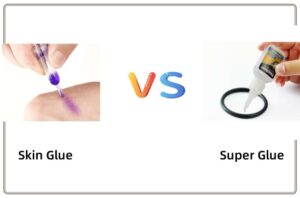
Surgical glue (medical-grade super glue) can quickly and firmly seal skin incisions and is commonly used for wound closure in laparoscopic appendectomy, offering a convenient, waterproof alternative to sutures.
It acts as a flexible antimicrobial barrier on the incision surface to reduce infection risks, eliminates the need for dressing changes and suture removal, improves cosmetic outcomes with minimal scarring, and allows patients to shower shortly after surgery.

How to Use Surgical Skin Glue to Seal Laparoscopic Appendectomy Incision
- Laparoscopic trocar incision
- Subcutaneous suture first
- Clean the wound surface, ensuring it is dry and free of blood.
- Approximate the wound edges and apply 2-3 thin layers of liquid skin adhesive. Do not apply it inside the wound.
The surgical skin adhesive will polymerize within 10-15 seconds, forming a flexible, waterproof, protective layer that acts as a “liquid bandage,” holding the skin together and sloughing off naturally in 7-10 days.
Surgical Glue vs Traditional Sutures in Appendectomy Surgery
Feature | Surgical Glue | Traditional Sutures |
Closure Speed | Faster | Slower |
Cosmetic Result | Better | Needle marks possible |
Need for Removal | No | Yes |
Waterproof Barrier | Yes | Limited |
Patient Comfort | Higher | Moderate |
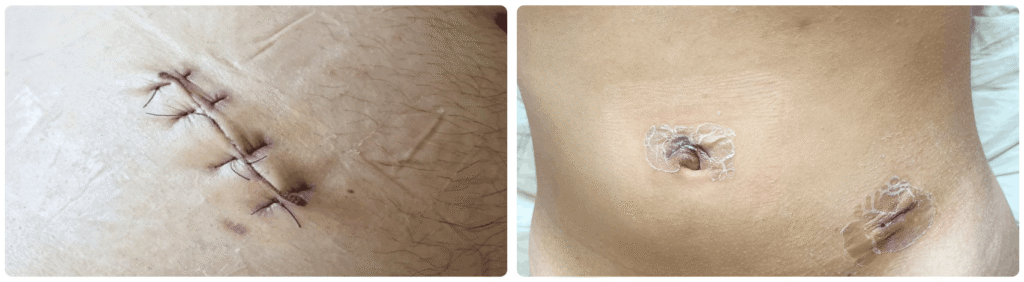
Clinical Considerations and Limitations of Surgical Super Glue
Surgical super glue is not a universal adhesive and cannot be used to close all wounds. It is not suitable for high-tension wounds or severely infected wounds; if used for closing deep skin wounds, it must be used in conjunction with sutures.
The surgical skin adhesive will polymerize within 10-15 seconds, forming a flexible, waterproof, protective layer that acts as a “liquid bandage,” holding the skin together and sloughing off naturally in 7-10 days.
Postoperative Care After Surgical Glue for Wound Closure
- Keep it dry and clean. After 48 hours, you can wash the area gently with water.
- Avoid rubbing. Do not pick or scratch it.
- Avoid swimming, soaking, or strenuous activity that could cause the wound to stretch and reopen.
- Do not use other products (e.g., liquids, ointments, lotions, creams, hydrogen peroxide, or alcohol) on the wound, as this may cause it to loosen prematurely.
When to Contact a Doctor
Seek medical attention if you notice signs of infection, such as:
- Increasing redness or swelling around the wound.
- The area feels hot to the touch.
- Increased pain or pus/foul-smelling drainage.
- The wound edges separate (come apart).
- A fever over 100.4°F
As laparoscopic appendectomy (LA) is rapidly becoming the dominant “gold standard” surgical approach for appendicitis, healthcare providers are placing greater emphasis on efficient wound closure, improved postoperative management, and enhanced patient experiences.
Particularly in laparoscopic appendectomy procedures with small, low-tension incisions, topical skin glue has become an increasingly popular alternative for superficial skin closure.
Zhejiang PerfectSeal New Materials Technology Co., Ltd. is a leading and trusted manufacturer of surgical skin adhesives in China, with an ISO 13485 medical device quality management system certification.
Its PerfectSeal® surgical skin adhesive for wound closure has biocompatibility that meets ISO 10993 standards and has obtained MDR/CE certification, making it safe for use in clinical wound closure scenarios.
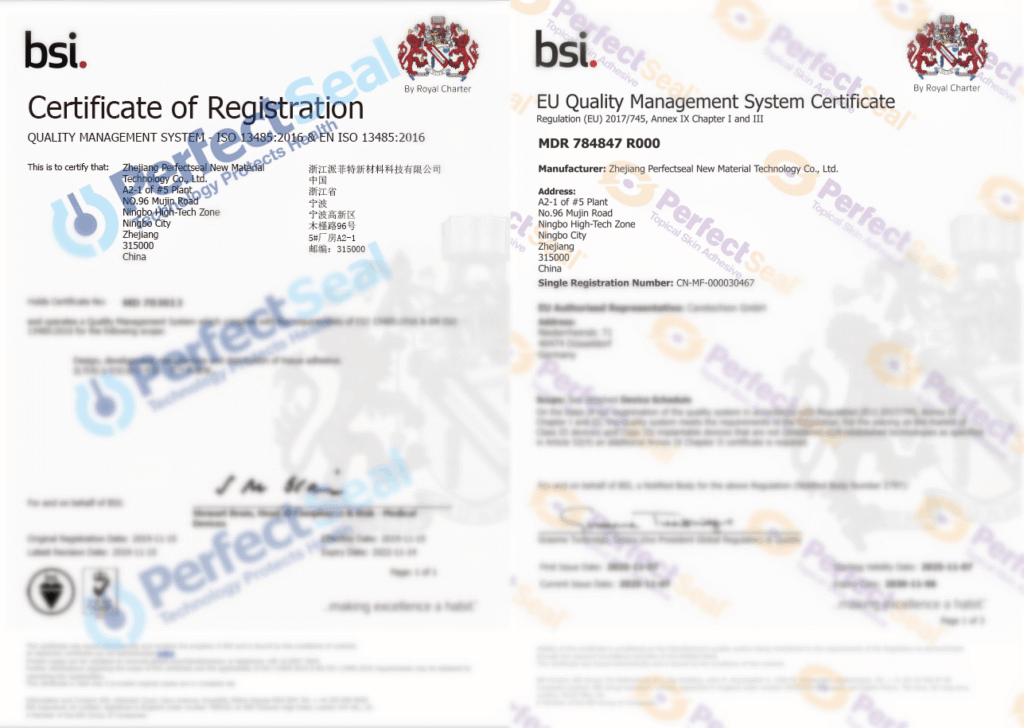
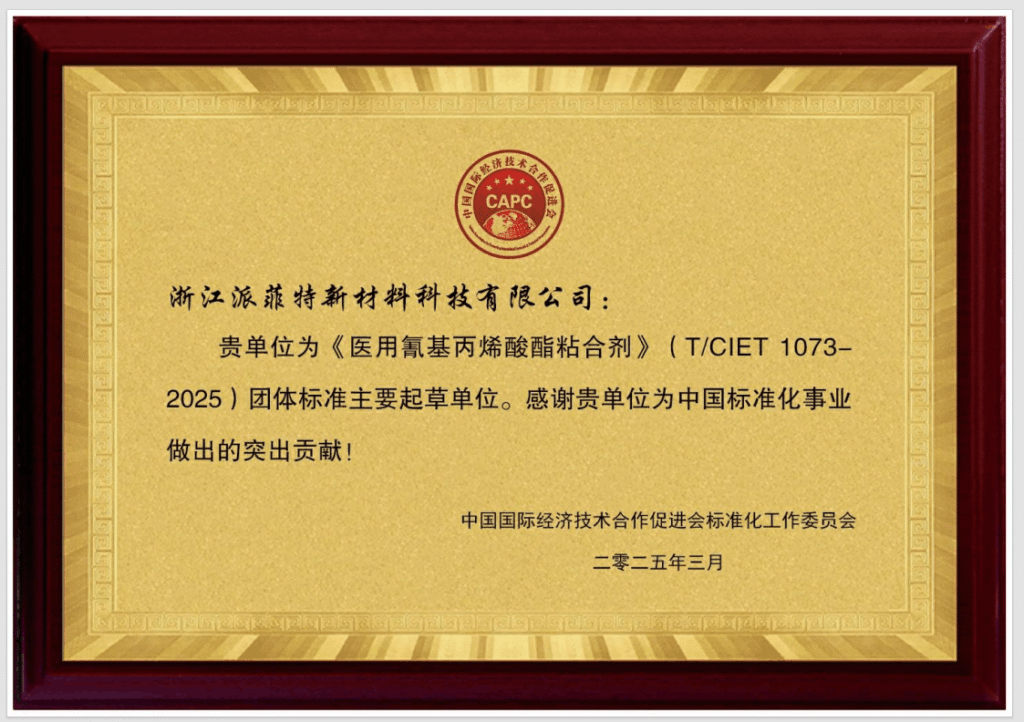
As a primary drafting unit of the “Medical Cyanoacrylate Adhesive Group Standard,” the company has deeply cultivated the field of medical cyanoacrylate skin adhesives, possessing extensive R&D experience and technical accumulation.
PerfectSeal® supplies high-strength n-butyl cyanoacrylate skin glue, high-flexibility 2-octyl cyanoacrylate skin glue, and Enbucrilate and Ocrilate composite formula skin glue. We can also provide customized formula liquid skin adhesive products and raw materials according to customers’ needs.
In addition, we offer OEM/ODM services, private-label support, and global distributor partnership opportunities for medical partners worldwide.
The company is equipped with a 100,000-level cleanroom and a professional R&D laboratory, establishing a comprehensive and detailed full-process inspection and testing and standardized quality control system—from raw materials entering the factory, process control, semi-finished product testing to finished product delivery.
Multi-link, full-process, strict testing is implemented to ensure the quality stability. Relying on mature capacity planning and production control capabilities, we can consistently meet the demands of large-scale mass production and high-volume, continuous order deliveries, providing safe, reliable, and high-quality medical wound adhesion solutions for clinical use.
Contact us to learn more about our surgical skin adhesive products and global partnership solutions.
REFERENCES
- Kim KE, Jeon YR, Bae SU, Jeong WK, Baek SK. Comparison between liquid skin adhesive and wound closure strip for skin closure after subcuticular suturing in single-port laparoscopic appendectomy: a single-center retrospective study in Korea. J Minim Invasive Surg. 2024;27:14–22. doi: 10.7602/jmis.2024.27.1.14. [DOI] [PMC free article] [PubMed] [Google Scholar]
- Soni A, Narula R, Kumar A, Parmar M, Sahore M, Chandel M. Comparing cyanoacrylate tissue adhesive and conventional subcuticular skin sutures for maxillofacial incisions–a prospective randomized trial considering closure time, wound morbidity, and cosmetic outcome. J Oral Maxillofac Surg. 2013;71:2152.e1–8. doi: 10.1016/j.joms.2013.08.029. [DOI] [PubMed] [Google Scholar]
- Lee CS, Han SR, Kye BH, et al. Surgical skin adhesive bond is safe and feasible wound closure method to reduce surgical site infection following minimally invasive colorectal cancer surgery. Ann Surg Treat Res. 2020;99:146–152. doi: 10.4174/astr.2020.99.3.146. [DOI] [PMC free article] [PubMed] [Google Scholar]